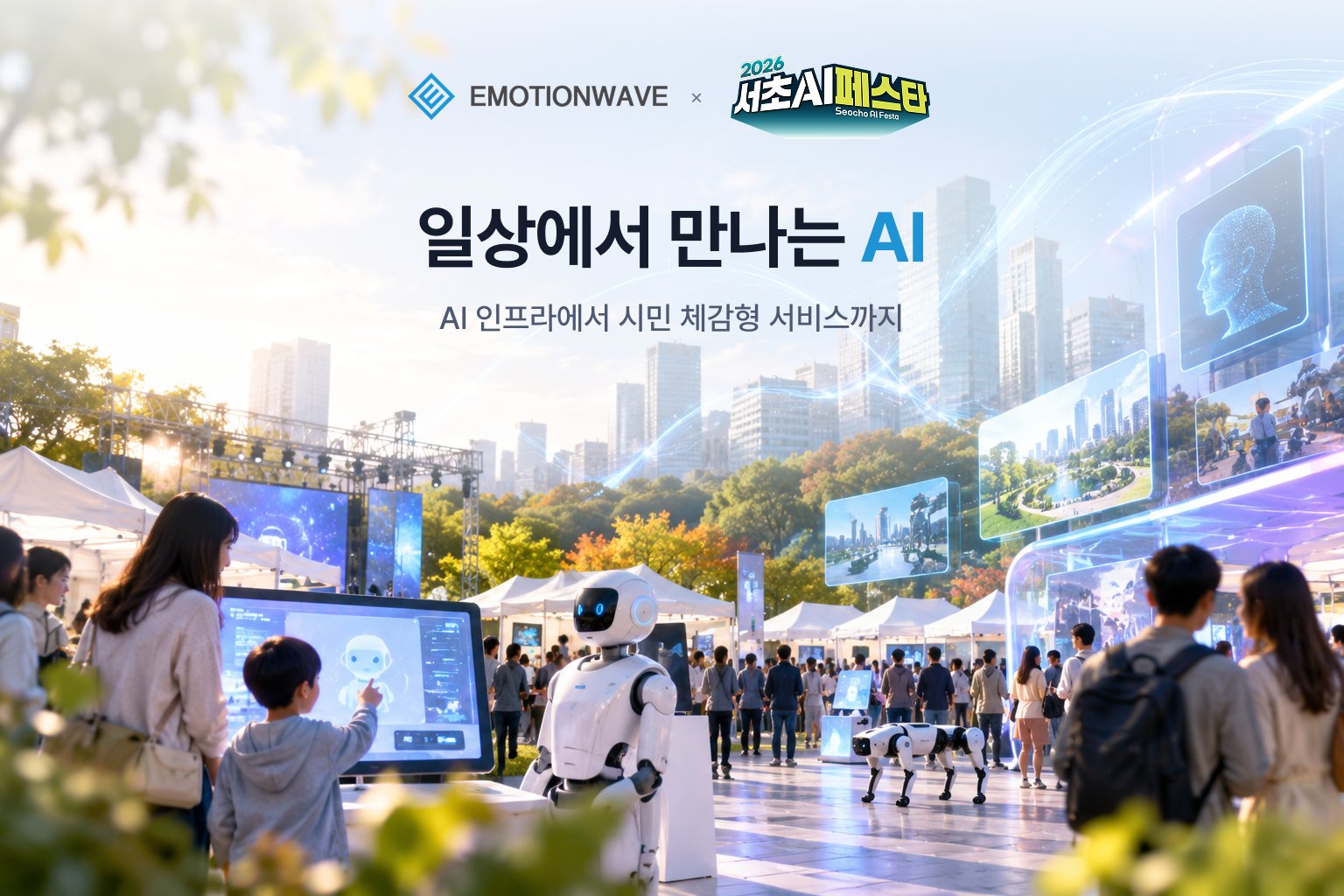
Connecting AI infrastructure, real-world applications, and Physical AI to bring intelligent services closer to everyday life
Artificial intelligence is rapidly expanding beyond research environments and enterprise applications into services that people can experience in their everyday lives.
As this transition accelerates, AI infrastructure is becoming increasingly important—not only for supporting computational workloads but also for enabling AI-powered applications to operate across public and industrial environments.
At the 2026 Seocho AI Festa, held on October 17 at Seocho Culture and Arts Park in Seoul, South Korea, Emotionwave showcased its approach to connecting AI infrastructure with practical, citizen-centric services.
Bringing AI Closer to Everyday Life
Hosted by Seocho District, the 2026 Seocho AI Festa provided an opportunity for citizens to explore how artificial intelligence can be applied across everyday life and various industries.
The event brought together AI companies and organizations to present interactive experiences, technology demonstrations, and AI-driven services.
For Emotionwave, the event highlighted a key direction in its technology strategy: expanding the role of AI infrastructure from supporting computing resources to enabling accessible, real-world applications.
Emotionwave provides AI infrastructure to the Seocho District Office, supporting the technical environment required to develop and operate various AI applications and services.
Among the examples are Seocho Coin and MUTA Games, an AI-powered gaming application designed to provide interactive experiences for citizens.
These applications demonstrate how AI infrastructure can serve as the foundation for services that people can directly access and experience.
AIMPLE: Supporting Efficient AI Infrastructure Operations
At the center of Emotionwave's AI infrastructure capabilities is AIMPLE, its proprietary AI infrastructure solution.
AIMPLE supports the efficient management and operation of AI computing resources, helping establish the technical foundation for a range of AI applications.
As AI services expand across different environments, infrastructure management becomes an essential part of supporting their operation and broader adoption.
Building on its infrastructure capabilities, Emotionwave is extending its technological applications into content generation, intelligent interaction, and other AI-driven services.
This approach reflects the company's broader vision of connecting underlying AI infrastructure with applications that deliver practical value.
Extending AI into Physical Environments
Beyond software-based applications, Emotionwave is also pursuing opportunities to integrate Physical AI into its technology ecosystem.
Physical AI represents the extension of intelligent systems into physical environments, creating possibilities for AI-powered interactions beyond conventional digital interfaces.
Emotionwave aims to connect AI applications with Physical AI technologies, expanding digital AI services into real-world spaces.
Through this approach, the company plans to explore new forms of citizen-centric AI services and develop an ecosystem capable of supporting applications across public and industrial environments.
This initiative remains part of Emotionwave's ongoing development direction as it works toward integrating infrastructure, applications, and physical-world AI technologies.
Building an AI Ecosystem for Real-World Impact
The 2026 Seocho AI Festa provided an opportunity for Emotionwave to share its direction for expanding AI infrastructure-based services and making AI more accessible to citizens.
Building on its collaboration with Seocho District, Emotionwave plans to strengthen connections among AI infrastructure, intelligent applications, and Physical AI technologies across public and private sectors.
By bringing these capabilities together, the company aims to support an AI ecosystem where technology can move beyond digital systems and become part of everyday experiences.
Emotionwave will continue advancing AI infrastructure and exploring practical AI services that connect technology with the real world.