mew DRUM On-Device AI Module Brand Image │Provided by - Emotionwave Emotionwave announced that it will unveil its new technological vision at 'The NAMM Show…
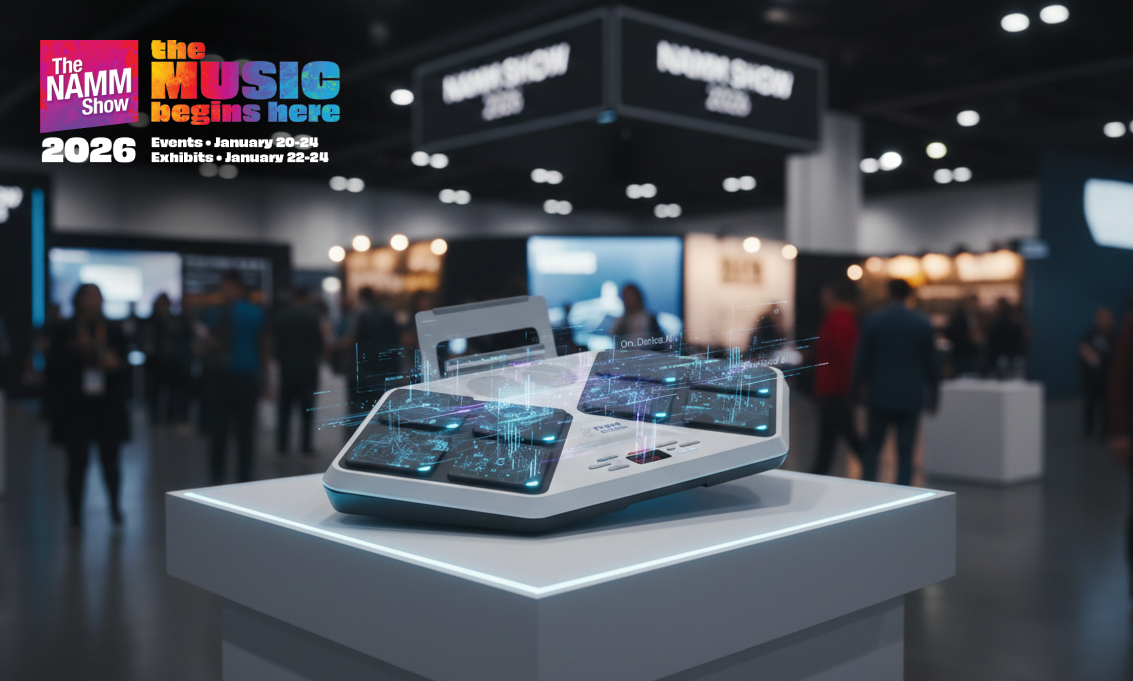
Emotionwave announced that it will unveil its new technological vision at 'The NAMM Show 2026,' a music and instrument exhibition, to be held from January 22nd to 24th at the Anaheim Convention Center in California, USA. At this exhibition, Emotionwave will showcase various technologies and solutions under the theme of 'Innovation in the North American Instrument Market through Physical AI-based On-Device AI and On-Chip (Web3) Architecture.'
The NAMM Show is the world's largest music industry event, attracting over 110,000 visitors annually and involving more than 7,000 global companies, with industry-leading companies such as Yamaha, Fender, and Roland participating to showcase the latest technologies and products.
Emotionwave emphasizes a physical AI strategy for instrument manufacturers at this exhibition. The company's technology is designed as an On-Device AI structure that operates on general-purpose SoC and MCU environments embedded in existing instruments, without requiring dedicated AI chips or attached devices, allowing manufacturers to introduce AI functionality without increasing the Bill of Materials (BOM).
The physical AI-based performance recognition technology analyzes the performer's timing, rhythm stability, and repeating patterns in real time directly inside the instrument through AI model lightweighting and on-chip optimization, providing immediate feedback. This expands the instrument beyond a simple playing tool into an intelligent platform capable of practice, learning, and feedback.
At NAMM Show 2026, mew DRUM On-Device AI modules for drums and rhythm instruments, along with the RIMA Physical AI Reference Architecture—which helps manufacturers quickly apply performance recognition functions to their own SoC/MCU platforms—will be introduced. This reference does not mandate a specific chip but provides firmware integration guides and implementation know-how.
Furthermore, Emotionwave proposes an architectural structure that enables on-chip Web3 module linkage, also suggesting the scalability to securely process performance data within the instrument and connect it with external platforms as needed.
Cheon Eun-hyung, a senior researcher at Emotionwave, said, "The key to introducing AI in the instrument industry is not changing the hardware, but adding intelligence on top of existing SoCs and MCUs," adding that "Emotionwave is presenting a realistic solution that can simultaneously expand the performance experience and product value while maintaining manufacturing costs."
Following technology verification at Music China (IMX) in October 2025 for the Asian and Eurasian markets, Emotionwave plans to fully strengthen its physical AI support partnerships with instrument manufacturers worldwide, including North America, leveraging the NAMM Show 2026.
Original article: By Ye-won Choi, Aving